Stormwater Management StormFilter stormwater filtration system.

The Stormwater Management StormFilter®

The Stormwater Management StormFilter® is an underground stormwater treatment device that houses rechargeable, media-filled cartridges that trap particulates and adsorb pollutants from stormwater runoff.
Find Your Local Sales Contact

Our local contacts are experts who are ready to help!

Flexible Stormwater Filtration Technology

As stormwater quality regulations become more stringent, engineers need a filtration device that can tackle the most challenging pollutants and provide the flexibility to meet the needs of a variety of sites.

The Stormwater Management StormFilter® is an underground stormwater treatment device that houses rechargeable, media-filled cartridges that trap particulates and adsorb pollutants from stormwater runoff such as total suspended solids, hydrocarbons, nutrients, metals, and other common pollutants. With media options to target multiple or specific pollutants and multiple system configurations, the StormFilter provides engineers with a flexible and reliable manufactured treatment technology. Its performance has been verified through field and laboratory testing by some of the most stringent stormwater technology evaluation organizations.

How the StormFilter Treats Stormwater

  • During a storm, runoff passes through the filtration media and starts filling the cartridge center tube. The air inside the hood is purged through a one-way check valve as the water rises. 
  • When water reaches the top of the float, buoyant forces pull the float free and allow filtered water to exit the cartridge. A siphon is established within each cartridge that draws water uniformly across the full height of the media bed ensuring even distribution of pollutants and prolonged media longevity. 
  • After the storm, the water level in the structure starts falling. A hanging water column remains under the cartridge hood until the water level reaches the scrubbing regulators at the bottom of the hood. 
  • Air then rushes through the regulators, breaking the siphon and creating air bubbles that agitate the surface of the filter media, causing accumulated sediment to settle on the treatment bay floor. This unique surface-cleaning mechanism prevents surface blinding and further extends cartridge life.

StormFilter Features and Benefits

Feature Benefit
Siphon actuated, high surface area media cartridges Stormwater is drawn evenly through the filter media providing efficient, effective stormwater treatment
Multiple cartridge heights Flexibility to meet site-specific hydraulic needs and reduce system size and costs
Multiple media options Ability to target specific pollutants of concern including TSS, phosphorus, and heavy metals
Internal peak bypass and multiple configurations Design flexibility to meet your unique site requirements
Maintenance intervals of one to five years Fewer maintenance events and reduced long-term ownership costs
NJDEP Certified and WADOE General Use Level Designation for Basic and Phosphorus Treatment Certified pollutant capture with confidence
Arrives at the jobsite fully assembled Factory assembly ensures quality and a simple, fast installation onsite

StormFilter Media Options

  • PhosphoSorb® - A lightweight media built from a Perlite base that removes total phosphorus (TP) by adsorbing dissolved-P and filtering particulate-P simultaneously.
  • Perlite - Expanded volcanic rock. Its porous, multi-cellular structure and rough edges make it effective for removing TSS and particulate bound pollutants.
  • CSF® Leaf Media - A granular organic media created from deciduous leaves, CSF is most effective for removing soluble metals, TSS, oil, and neutralizing acid rain.
  • ZPG™ - A proprietary blend of zeolite, perlite, and GAC to improve the performance of perlite and target organics, soluble metals, and other pollutants.

StormFilter Cartridge Options

Flexibility to reduce size and costs...

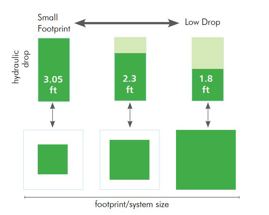
Every site is different, and one size does not fit all. Multiple cartridge heights give you design flexibility to design the StormFilter specifically for your site and reduce the cost of the system for the owner.

  • 27” cartridge – Capitalizes on sites with at least 3.05 feet of available driving head, media surface area is maximized to allow the greatest treatment rate per cartridge; best for sites with footprint constraints
  • 18” cartridge - Provides a middle ground and operates with 2.3 feet of driving head
  • Low Drop – Provides filtration treatment with only 1.8 feet of headloss; best for sites limited by hydraulic constraints

Select StormFilter Approvals

  • Washington State Department of Ecology (TAPE) GULD – Basic, Phosphorus
  • New Jersey Department of Environmental Protection (NJDEP)
  • Canada ISO 14034 Environmental Management – Environmental Technology Verified (ETV)
  • North Carolina Department of Environmental Quality (NC DEQ)
  • Maryland Department of the Environment (MD DOE)
  • Texas Commission on Environmental Quality (TCEQ)
  • Virginia Department of Environmental Quality (VA DEQ)
  • Maine Department of Environmental Protection (ME DEP)
  • St. Louis Metropolitan Sewer District
  • Sacramento Stormwater Quality Partnership (SSQP) 

StormFilter Configurations

Flexibility to accommodate flows, project footprints, and hydraulics ...

The structures that house the filter cartridges can be constructed in a variety of ways to accommodate a wide range of flows, project footprints, and variable hydraulic conditions. Standard configurations include catch basin, manhole, vault, and curb inlet.  Advanced configurations include: 

  • The Peak Diversion StormFilter provides treatment and high-flow bypass in one precast vault, eliminating the need for an external bypass or junction structures.
  • The Cast-in-Place StormFilter structures allow the highest degree of flexibility and are available for installations within buildings or other areas where precast structures cannot be accommodated. On-site Contractor assistance is provided to ensure the finished product meets Contech’s standards for fit and function.

StormFilter Maintenance

The StormFilter is designed for simple, predictable maintenance that helps reduce long-term operating costs. All StormFilter structures provide easy access for inspection, media replacement, and cleaning. 

StormFilter maintenance typically includes:

  • Removing accumulated sediment and debris from the treatment bay.
  • Inspecting cartridges and replacing media as needed, typically every 1–5 years depending on site conditions.
  • Cleaning the structure and confirming that inlet, outlet, and drainage components are clear.
  • Replacing cartridges as needed. Replacement cartridges can be shipped to the site ready to install, with used cartridges returned for refurbishment.
  • Using Contech Certified Maintenance Providers for inspection, cleaning, and cartridge replacement, if desired.
Installation of three Jellyfish stormwater filtration devices.
High Volume Applications

Designing, manufacturing and installing high-volume stormwater detention and treatment systems requires expert engineering, planning, and logistical support to manage costs and keep the project on schedule and under budget. When you need a proven, large scale stormwater management system, “Go Big” with Contech.

Construction workers install a large concrete structure with pipes at a construction site, with buildings in the background.
Filtration Systems for Water Quality

The Stormwater Management StormFilter, Jellyfish Filter, and the Kraken Filter provide the highest level of treatment and meet the most stringent regulatory requirements. These low maintenance systems combine pretreatment and filtration, and are able to target site-specific pollutants to meet your water quality goals. Our field-proven products have earned hundreds of standalone BMP approvals from regulatory agencies nationwide.

A parking lot with white barriers on the right and a sidewalk with piled rocks and vegetation on the left. A concrete slab is visible.
Pretreatment for LID Designs

The Stormwater Management StormFilter, Jellyfish Filter, and the High Capacity Kraken Filter can be easily configured as decentralized pretreatment systems for Low Impact Development Designs. 

Concrete structure labeled "Reese Contech Jellyfish Filter" at a coastal excavation site near the ocean.
Filtration for Removing Pollutants Prior to Discharge

Media filtration systems - like our StormFilter, Jellyfish Filter, and Kraken Filter are able to remove the most challenging pollutants from stormwater, including total phosphorus, soluble metals, oil, and very fine particles. Available in a variety of configurations (vault, manhole, catch basin, high flow and volume), these systems can be engineered to treat a wide range of flows within your drainage system and capture pollutants prior to discharge off-site.

StormFilter FAQs

Many regulatory agencies have established criteria for sizing stormwater treatment devices to meet their water quality standards. Depending on local requirements, the StormFilter may be sized using flow-based, volume-based, or attenuated/mass-based methodologies. Please refer to the Sizing Methodologies for the Stormwater Management StormFilter document for specific guidelines.

For flow-based preliminary sizing, the water quality treatment flow rate is required. If the unit needs internal bypass, Contech will also need to know the peak storm flowrate. For volume and mass-based/attenuated designs, please contact your local Contech Stormwater Consultant for the necessary criteria to properly size the system adhering to local requirements.

StormFilter cartridges are typically replaced every 1 to 5 years, depending on site conditions, pollutant loading, and maintenance frequency. Routine inspection and maintenance should be used to determine actual replacement timing. Sites with higher sediment, trash, or construction-phase loading may require more frequent service or earlier cartridge replacement.

A detailed maintenance decision tree can be found in the StormFilter Inspection and Maintenance Guide.

StormFilter maintenance costs differ based on several factors, including the size of the vault or manhole, the number and height of cartridges that need to be replaced, site access considerations, geographic location, disposal requirements, and local labor rates. Maintenance frequency can also affect cost and is influenced by site conditions such as sediment loading, trash and debris accumulation, upstream pretreatment, and the amount of runoff treated by the system.

Because these variables can vary significantly from site to site, StormFilter maintenance costs are typically evaluated on a project-specific basis. For the most accurate estimate, contact a Contech Certified Maintenance Provider to review the system size, cartridge count, site layout, and inspection history.

Manufacturing America's Infrastructure™


Agency/Regulatory Guidance

Our team is ready to provide you with expert advice and assistance on local regulatory requirements, resulting in faster approvals.


Solution Development

Our engineers can review your requirements, weigh all options, and recommend the optimal solution to integrate with your site designs.

Technical Expertise

Our engineers can assist by providing product specific engineering calculations such as hydraulics, buoyancy, foundation reactions, and unit sizing.

Cost Estimates

We can quickly provide engineer’s cost
estimates to assist with your solution
selection process.

Site Specific Drawings

Our engineers can provide site-specific drawings for proposals, project meetings, and submittals, helping you be more efficient with your time.

On-site Assistance

Contractors know time is money, so we provide preconstruction meetings, delivery coordination, and on-site installation support to ensure a timely, smooth installation.