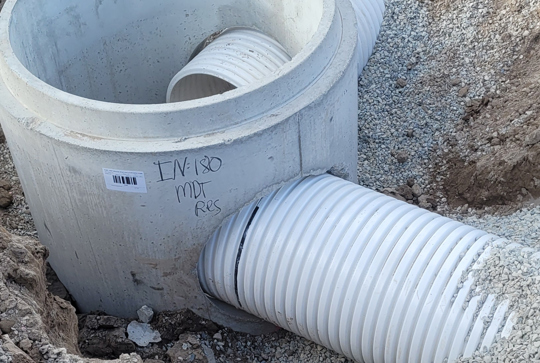
Most storm sewers are simply grouted into a manhole using non-shrink grout and a water-stop gasket, when appropriate. Contech has supplied both the “double fluted” and “single fluted” pipe gaskets for the “water-stop”, which is simply used to help the concrete/grout adhere to something other than the very smooth/slick PVC surface.

As America’s infrastructure expands, the demand for reliable sewer systems is growing rapidly—industry forecasts suggest over 700 million linear feet of sewer pipe installations by 2026. For larger-diameter systems (say 30 inches and up), ensuring the integrity of pipe joints becomes both more important and more challenging.

Trench boxes provide essential worker safety when installing pipe in deep trenches or unstable soils. However, their use with large diameter flexible pipes presents a critical challenge: maintaining compacted embedment integrity during trench box movement. Improper technique can create voids alongside the pipe or reduce backfill density adjacent to the pipe, eliminating the lateral support that flexible pipes require to control deflection.

Buried pipelines are often “out of sight, out of mind,” but protecting them during construction is critical. Heavy equipment loads can exceed design limits, requiring additional temporary or permanent cover to prevent damage. Contractors must locate and mark buried pipes, then use cover-height tables—based on equipment type and load details—to determine proper protection. By applying the right cover and maintaining it throughout grading, paving, and other activities, contractors can safeguard installed pipelines and avoid costly failures.

When it comes to drainage solutions in aggressive environments, material selection makes all the difference. Traditional galvanized corrugated metal pipe often struggles to withstand the corrosive effects of saltwater, brackish water, and hypersaline soils. That’s where Corrugated Aluminum Alloy Pipe (CAP) stands apart.

America’s Wastewater Infrastructure is currently rated at a D+, according to the 2025 ASCE Report Card for America’s Infrastructure. The Wastewater category includes both piping for the collection systems and the wastewater treatment plants the piping leads to. The collection system alone experiences 3.3 failures per 100 miles of pipe every year, putting pressure on maintenance teams to identify suspect pipes for either complete replacement or pipeline rehabilitation. This article will focus on the design and construction considerations necessary when a pipeline owner determines they will be rehabilitating an existing pipe.

Unlike circular pipes, arch-shaped culverts present a unique challenge when it comes to structural rehabilitation. Their non-round geometry and sometimes integrated parapet walls mean that standard sliplining methods don't always apply. However, just because a culvert isn’t round doesn't mean it can’t be effectively relined.

Why have a preconstruction meeting for pipe? Engineers have been designing various types of pipe for hundreds of years, while contractors have been installing it for hundreds of years. What needs to be discussed? It’s fair to say that all stake holders (owner, engineer, contractor and manufacturer) want a successful project. Taking the time a week prior to installation to cover key items will save time, and money, by recognizing and mitigating any issues before they arise.
SUBSCRIBE
The Pipe Blog is featured on the Contech Site Solutions Newsletter. Get insights, news, tip & tricks delivered directly to your inbox. Sign Up Today to Receive.