
Managing Hydroplaning Risks on Airport Runways and Taxiways
Hydroplaning
Hydroplaning occurs when the tires of a vehicle or aircraft lose contact with the pavement surface due to the presence of water. As aircraft speed and water depth increase, water pressure builds beneath the tire, creating uplift forces that reduce friction between the tire and runway surface. When this happens, the aircraft can lose traction and directional control, resulting in hydroplaning conditions.
On airport runways and taxiways, hydroplaning is a serious safety concern that can affect aircraft of all sizes. Excess surface water during rainfall or snowmelt events can significantly impact braking performance, steering control, and overall runway safety.
While pilots can help reduce hydroplaning risks through proper tire inflation, controlled landing speeds, and smooth braking techniques, airport engineers play a critical role in minimizing standing water through effective surface drainage design and stormwater runoff management.
Rainwater Sheet Flow Interception
One of the most effective methods for managing surface runoff on wide, flat paved areas is the use of Steel Slotted Drain systems. Steel Slotted Drain is commonly used to intercept rainwater sheet flow on airport runways, taxiways, maintenance areas, highways, municipal streets, and parking lots.
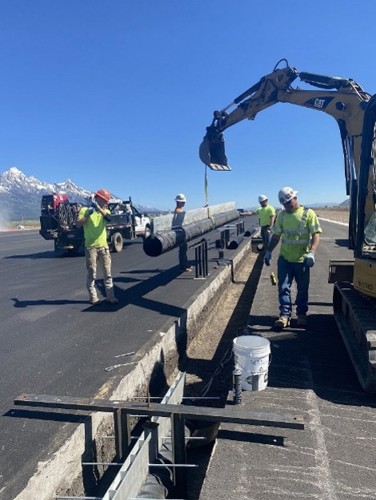
In airport applications, the slotted drain is typically installed transverse to the direction of rainwater or snowmelt flow. The continuous grated opening allows runoff to enter uniformly along the entire length of the drain, efficiently capturing water before it can accumulate on the pavement surface.
The hydraulic performance of slotted drain systems has been extensively evaluated through testing conducted by the Federal Highway Administration (FHWA). Findings from these studies are documented in FHWA Report FHWA-RD-19-106, Hydraulic Characteristics of Slotted Drain Inlets.
Steel Slotted Drain: Designed for Airport Runoff Management
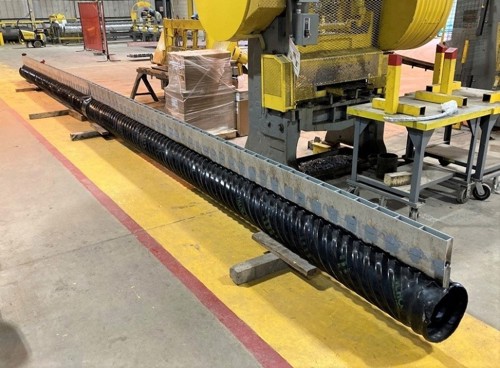
Steel Slotted Drain systems are fabricated from corrugated steel pipe available in diameters ranging from 10 inches to 36 inches. The pipe is modified along the crown with a continuous longitudinal slot and fitted with a reinforced, hot-dip galvanized steel grate that creates a continuous 1-3/4-inch opening.
This design allows surface runoff to enter through the slot and flow directly into the pipe invert below, where it is conveyed safely to an outlet structure or collection system.
Steel Slotted Drain is available in multiple material options to meet varying environmental and service-life requirements, including:
- Galvanized corrugated steel pipe
- Aluminized Type 2 (ALT2) corrugated steel pipe
- Polymer Coated corrugated steel pipe
For airports where de-icing chemicals and corrosive runoff are present, Polymer Coated Steel Slotted Drain can provide enhanced durability and extended service life.
Built for Heavy Aircraft Loading
The design and structural strength of Steel Slotted Drain make it well-suited for demanding airport environments. The high tensile strength of steel provides the durability necessary to withstand direct wheel loading from heavily loaded aircraft while maintaining long-term hydraulic performance.
For more than 56 years, Steel Slotted Drain systems have been successfully used to intercept rainwater sheet flow and improve surface drainage performance in airport applications across North America.