

Wondering how much backfill to put over your stormwater systems?
We’ve got you covered!
Being buried under dirt might be one of the most common fears people have. However, if you were a stormwater management device (or the human designing it) you might begin to worry about not having enough dirt over your system. How much is enough earth cover? Can I put too much? What backfill materials are suitable? Whether you are designing a hydrodynamic separator, a filter, or any of the diverse options of detention and retention systems, you need to know the answers to these questions, and we are here to help.
Detention/Retention Systems:
The earth cover needed over your corrugated metal pipe (CMP) detention or retention systems is typically governed by the diameter and the type of pavement over the system. For the most common diameters, CMP needs around 1’ of earth cover; for pipes with a diameter over 96” the cover is usually 18”. If you have flexible pavement (asphalt, grass, etc.) over the system, the pavement depth cannot be accounted for in the overall earth cover. However, if you had rigid/concrete pavement over your system, its depth could be used as part of the earth cover needed. There is a limit as to how much earth cover can be over CMP system; but this is rarely a limiting factor as the pipe, and fittings can be reinforced accordingly in most cases. For more information regarding the maximum cover for specific diameters and gages, please see the “Heights of Cover” table on page 10 of the CMP design guide.
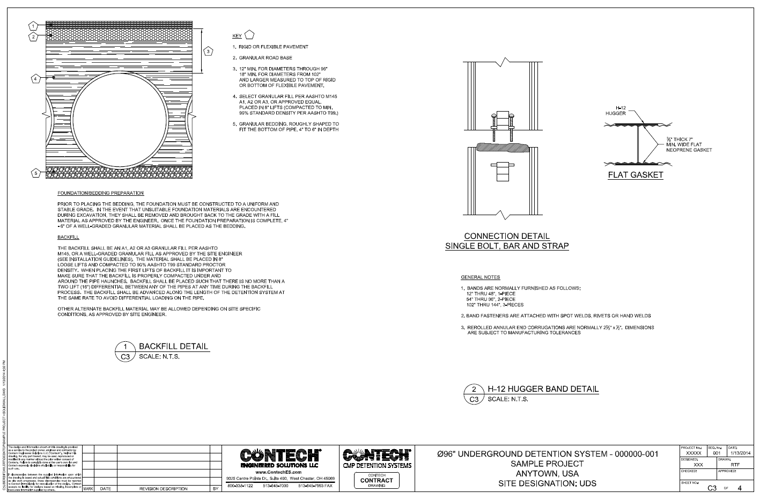
In plastic retention/detention systems, the earth cover needed is usually a bit higher compared to metal, and it does have an upper limit. This applies to both plastic pipe and chambers. Their minimum and maximum earth cover are usually listed on their respective backfill details. The same rules about flexible and rigid pavements would apply to both plastic and metal systems. Commonly, Chambermaxx chambers have a minimum cover of 18” and a maximum cover of 96”. The minimum and maximum earth cover over Duromaxx plastic pipes are listed on the tables below. The materials that are suitable for backfilling detention/retention systems are always stated in the backfill details (see image 1). Some systems use both pipe and stone storage, while others only use pipe storage. For systems that only use pipe storage, the backfill should be from a material that conform with AASHTO soil classifications: A-1, A-2, or A-3. For systems that need stone storage, the stone perimeter should use free-draining, angular, washed stone that confirms with AASHTO M 43: 3, 357, 4, 467,5, 56, 57, or an approved equal.
Combined reference table for minimum and maximum cover requirements.
|
Product |
Diameter Range |
Minimum Cover |
Maximum Cover |
|
Aluminized CMP |
30”-96” |
12” |
No limit |
|
Aluminized CMP |
102”-144” |
18” |
No limit |
|
DuroMaxx Detention |
30”-42” |
12” |
50’ |
|
DuroMaxx Detention |
48"-60" |
12" |
30' |
|
DuroMaxx Detention |
66”-72” |
18” |
30’ |
|
DuroMaxx Detention |
78"-96" |
24" |
30" |
|
DuroMaxx Detention |
108” |
30” |
25’ |
|
DuroMaxx Detention |
120' |
36' |
25' |
|
ChamberMaxx Chambers |
— |
18” |
96” |
Note: ChamberMaxx Chambers do not use a diameter range in the same way as the pipe products.
Image 1 – Example backfill detail
Concrete Treatment/Detention:
How much cover can be over concrete systems like Contech's UrbanPond? The answer to that question will vary depending on the unit's structural design and groundwater elevation. There are standard structural designs that are commonly used in units with no extreme conditions. However, your Contech team will help assess if a special structural design is needed on a project with uncommon conditions to ensure the vault or manhole is properly reinforced. Projects located in airports, seaports, or in areas with loading conditions higher than normal traffic loads usually require these structural drawings which always list the minimum and maximum earth cover. If you believe your unit requires a special structural drawing, please let your local Contech representative know, and they’ll be able to account for any special loading conditions and let you know if a special structural design is needed.
Hopefully, most of your questions regarding earth cover have been covered (and properly backfilled). But if you have any remaining doubts to be buried, please feel free to contact us.