

Stormwater Detention Systems: The Ins & Outs of Inlets & Outlets
Designing underground detention systems that perform as intended from first drop to final discharge.
Underground detention systems are often evaluated by storage volume, depth, and footprint, but the real performance impact starts and ends at the inlets and outlets. These connection points control how water enters the system, how energy is managed, and how reliably the system releases flow at the intended rate. In this post, we’ll break down the most common design questions engineers ask about inlets and outlets, so your system performs predictably, stays maintainable, and meets hydraulic goals.
1. Sizing inlets and outlets so they don’t limit system performance
A detention system can meet the required storage and still underperform if the inlet or outlet becomes a bottleneck. Many design issues show up when the inlet is too restrictive, causing backups upstream. The outlet may unintentionally control flow and therefore create drawdown concerns or reduce available storage during back-to-back events by acting as an orifice control.
Common inlet/outlet bottlenecks include:
- Undersized lead-in pipes or too few inlet points feeding a large system
- Excessive head loss through structures, fittings, or abrupt transitions
- Grates, hoods, or screens that restrict flow during surcharge conditions
- Outlet structures that are physically constrained or hard to maintain
- Tight inlet or outlet areas which may be prone to clogging from foreign debris accumulation
Design the inlet and outlet so they support the system’s intended hydraulics rather than accidentally “redefining” them.
What to check during design review:
- Does the inlet have enough capacity for the controlling event without creating backups upstream?
- Is the outlet device (orifice/weir/vortex control) the intentional control point instead of the pipe, fitting, or structure configuration?
- If the system surcharges, is the flow path still predictable and stable?
2. Protecting the system from sediment, trash, and floatables?
Pretreatment is one of the most important design decisions for long-term reliability. Without it, sediment and debris can reduce storage volume, increase maintenance frequency, and create outlet clogging risks, especially on sites with high sediment loading.
Pretreatment serves three main purposes:
- Protect storage volume by capturing sediment before it enters the system
- Protect outlet controls by reducing clogging potential
- Improve maintainability by concentrating maintenance where it’s easier and safer
Common pretreatment approaches include:
- Hydrodynamic separators (HDS): effective for capturing sediment and floatables and keeping maintenance upstream and accessible
- Sumped structures / deep sumps: basic sediment collection
- Forebays/sediment traps: useful in larger spaces with large sediment loading
- Filtration pretreatment: used when additional pollutant reduction is needed
If maintaining a single upstream structure, rather than entering an underground detention system for inspection and maintenance, is preferable, pretreatment should be incorporated into the design.
3. Handling high flows, surcharging, and bypass events
Underground detention systems are designed to detain a specific storm event, but real-world conditions don’t always follow these design constraints. High-intensity events, downstream restrictions can cause surcharging and high-energy inflows.
Engineers typically want two things:
- Predictable hydraulic behavior during high flows
- Protection of storage and outlet components under surcharge conditions
Key design considerations:
- Inlet energy management: high-velocity inflows can scour the inside of a system, mobilize sediment, and create turbulence that disrupts performance
- Flow distribution: large systems often benefit from multiple inlet points [KT1.1]to reduce concentrated inflows and improve distribution
- Bypass strategy: when flows exceed treatment or water quality requirements, ensure bypass flows are diverted intentionally and safely
A simple question can catch problems early: If the system surcharges, where does the water go, and is that path acceptable?
4. Determining outlet control design
Outlet design is where engineers balance hydraulic control and maintainability. The best outlet strategy depends on design requirements and site-specific details.
Typical objectives include:
- Peak rate control (detention): manage downstream capacity and reduce peak discharge
- Water quality / volume-based capture: manage a defined runoff volume
- Multi-event performance: balance small-event control with safe large-event conveyance
Common outlet strategies:
- Orifice plates: simple and common, but must be protected against debris accumulation and maintenance challenges
- Weirs: effective at certain heads and can provide more stable performance in multi-stage designs
- Multi-stage outlet structures: allow small storms and large storms to be managed intentionally with different controls
- Vortex controls: useful when a compact outlet device is preferred (and when maintenance access is available)
Make the outlet control device easy to locate, access, and clean. If it’s hard to reach or inspect, the risk of long-term underperformance increases.
5. Choosing inlet and outlet pipe materials
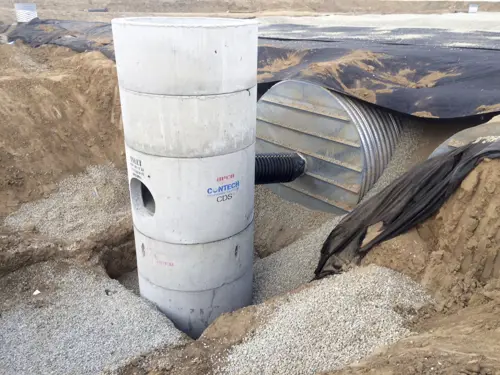
A common question is whether a CMP detention system requires the storm sewer inlets and outlets to also be corrugated metal pipe. In most cases, the inlet and outlet pipes do not need to match the detention system material. What matters is designing the connection in a way that maintains hydraulic performance, structural integrity, and long-term reliability.
Engineers routinely tie CMP detention systems into storm sewer networks made from a variety of materials, including RCP, HDPE, PVC, and ductile iron, depending on site standards, jurisdictional requirements, and project constraints. The key is ensuring the transition is detailed correctly, including proper structure selection, watertightness (when required), alignment, and constructability. A well-designed connection should support the design flow, avoid becoming an unintended restriction, and remain accessible for inspection and maintenance over the life of the system.
Therefore, the detention system material doesn’t require matching inlet/outlet pipe material-- the connection detail is what matters.
Designing for real-world performance
Inlets and outlets aren’t just connection details; they control the performance of underground detention systems. When they’re sized correctly, protected with pretreatment, designed for high-flow behavior, and tied-in with well-detailed transitions, the system performs the way it was designed to perform, not just on paper, but in the field